BACK TO LINKS.....................BACK TO MAIN
CAUTION: You need a scuba tank to inspect the bottom drain, holding your breath too long can make you dizzy and can be bad for your health.
The bottom drain is a common place for a leak to develop. Most leaks are easy to find, but use a mirror to see inside of grooves can help quite a bit.
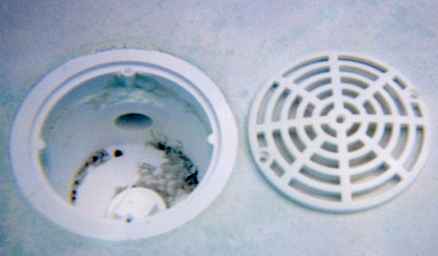
The lids are held on with 2 Phillips (+) screws, then the top pops off to reveal the bottom drain pot. The pipe from the bottom drain usually runs to the skimmer. If there are 2 pipes in the skimmer it is the one in closest to the pool. It is a good idea to plug off this pipe at the skimmer before you dive so you can check for a broken drainpipe while you are down there.
Bottom drains are of 2 types: 1piece and 2 piece. Some 2 piece bottom drains can look like one piece so look carefully.
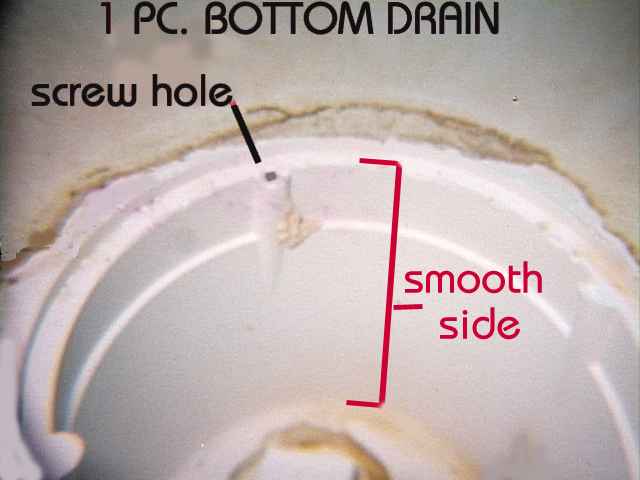
The one-piece drain has a smooth side with only 1 ring running around the pot. It has no grooves or ridges and usually leaks only in one place: Between the cement and the outside of the plastic pot (In cement pools that have been fiberglassed, this leak is still common because the resin will not stick to the plastic).
To the left: the discolored ring on the outside of the pot is the leak. It is thin and spread around the entire drain.
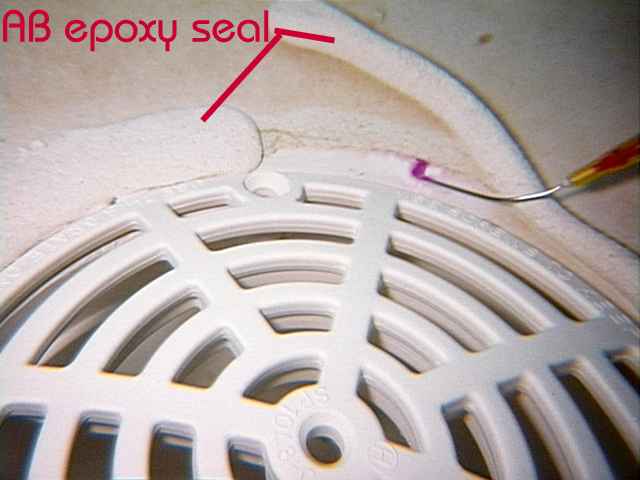
After the ring is cleaned with a wire brush, an epoxy seal is smoothed all around the pot. Notice the tip of the syringe squirting the dye into the crack. This leak is very active.
THE 2 PIECE BOTTOM DRAIN:
When a pool has been refinished, an extension collar (left) is added to
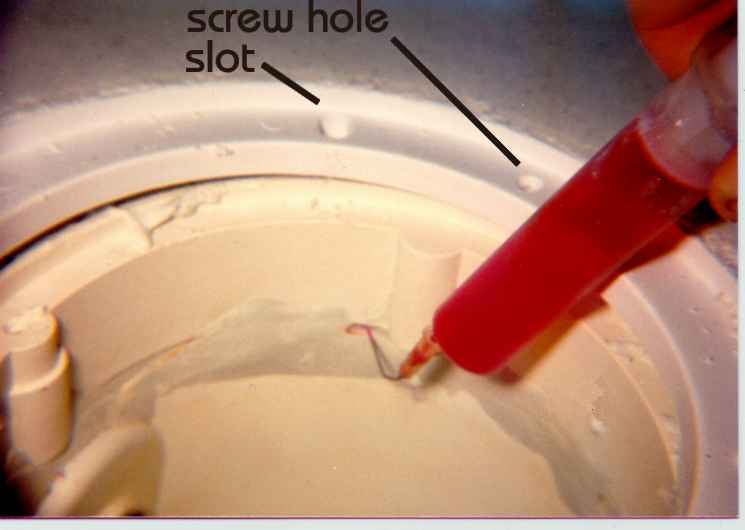
the bottom drain to give room for the new cement. Some new pools are built with a 2-piece bottom drain and the leak is usually between one of the extension collars (viewed best with a mirror). If your pool has a collar with some grooves in it, fill the grooves in with epoxy. NOTE: in the picture in the upper right, the leak and upper groove were sealed with epoxy. The leak continued through the screw hole and slot. Always double-check your work when you think you're finished!
Notes: A leak in the bottom drain can and will plug itself with derbies. If your pool drains to a certain level and stops, don't rule out the bottom drain.
An epoxy repair of the bottom drain is under tremendous pressure from the weight of the water and can push the epoxy right through the leak before it dries. Mix the epoxy with sand to form a thicker epoxy mixture.
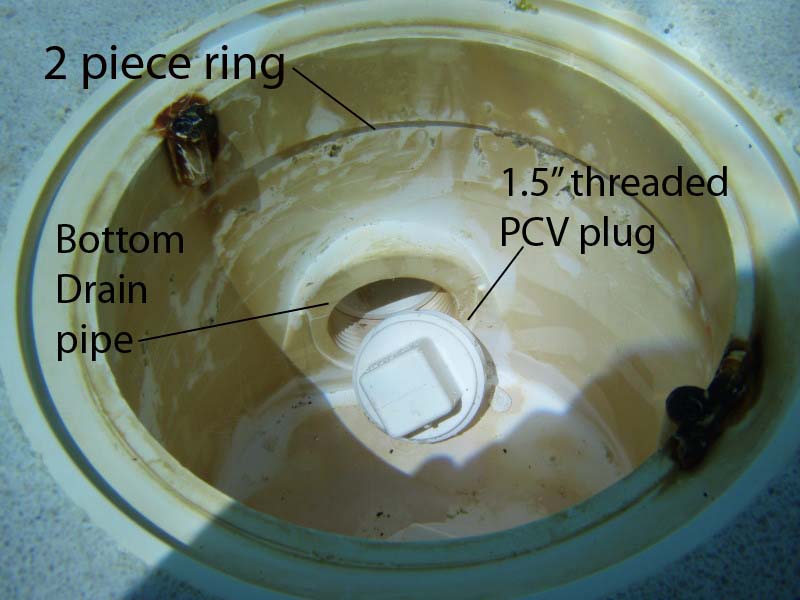 This
picture is a good example of a 2 piece bottom drain- see the ring about 1"
down. This ring should be inspected with the mirror. To seal this ring, scrub
with sandpaper and seal with epoxy.
This
picture is a good example of a 2 piece bottom drain- see the ring about 1"
down. This ring should be inspected with the mirror. To seal this ring, scrub
with sandpaper and seal with epoxy.
Also some bottom drains can be plugged of with a 1.5" PVC plug available at hardware stores.
BROKEN BOTTOM DRAIN PIPES:
If your pool is loosing more than a 1/2" per day then a broken bottom drain pipe is easily found. First, plug off the other end of the drainpipe (usually in the skimmer), if the skimmer has 2 pipes in the bottom, the bottom drainpipe is the pipe closest to the pool. If you don't have a plug you can stuff a sock in it to do this quick test. Swim to the bottom (do not make waves), and place a small stream of dye in the mouth of the pipe in the bottom drain. If the pipe is broken, the dye will slowly draw into the pipe-about the speed that a small ant walks. If the dye just sits there, or blows in and out, its not the bottom drain-go remove and recheck the light.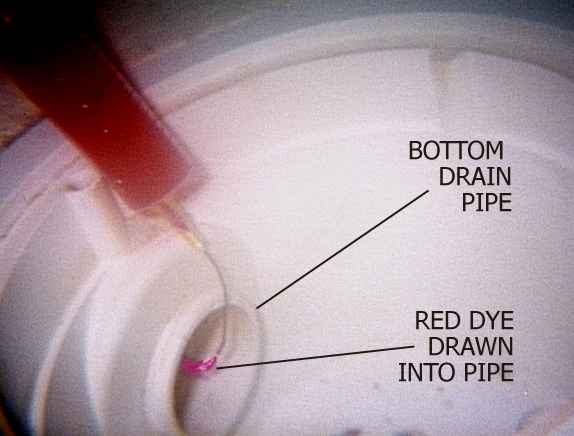
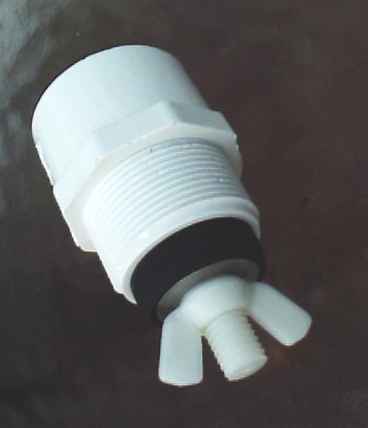
If the bottom drainpipe is broken, it is best to eliminate the pipe system completely (trust me, you cannot dig that far under the pool) The plug size generally used is smaller than 11/2" in diameter. Above, right- a plug that fits the inside a 11/2" male adapter will plug off the bottom drain.
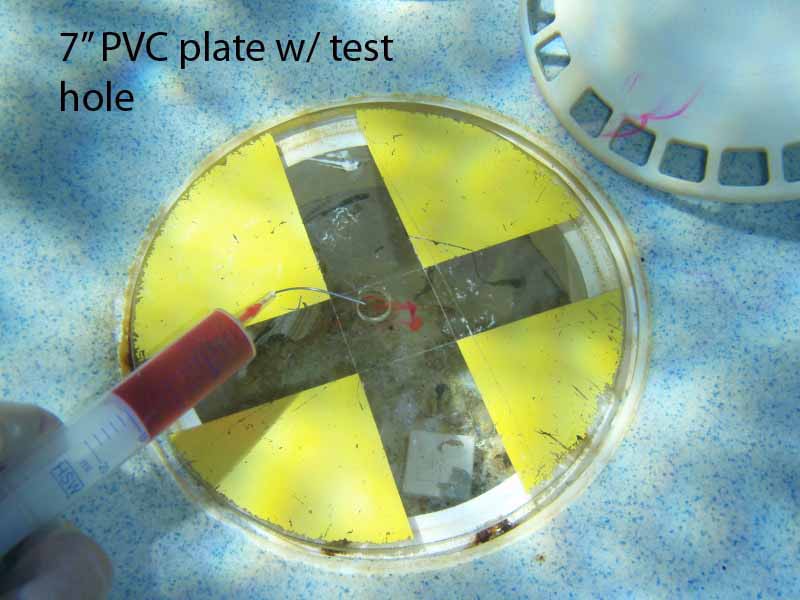
This 7" plate has a hole drilled in the middle to reduce the crosssection for dye testing. Providing the drain pipe is isolated at the other end, if the leak is under this plate the dye will be drawn into the hole. Then you can isolate areas of the drain by plugging off the pipe.
If you don't want to cut out a plate like this one, most circular saw blades are 7" in diameter and have the hole in place. We used a 7" masonary (black fiber) blade for a while.
These plates can be used with multible drains, but only one plate will have the hole for testing.
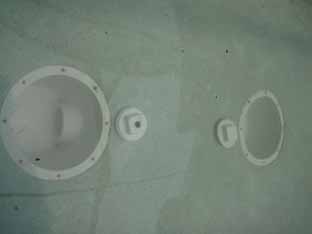
These 2 drains are in the bottom of a spa. The threaded caps (1 with a hole/ 1 without) will be used to dyetest the Tee joint under the spa.
BACK TO LINKS.........................BACK TO MAIN ................................TOP